
OKR vs KPI in Malaysia: The Ultimate Guide to Setting Goals That Drive Growth
Are your company’s goals truly driving progress, or are they just numbers on a spreadsheet? For many HR managers and business leaders in Malaysia, setting and tracking meaningful objectives is a constant challenge. You want to inspire your team to reach for the stars, but you also need to keep the daily operations running smoothly. This is where the debate of OKR vs KPI often begins.
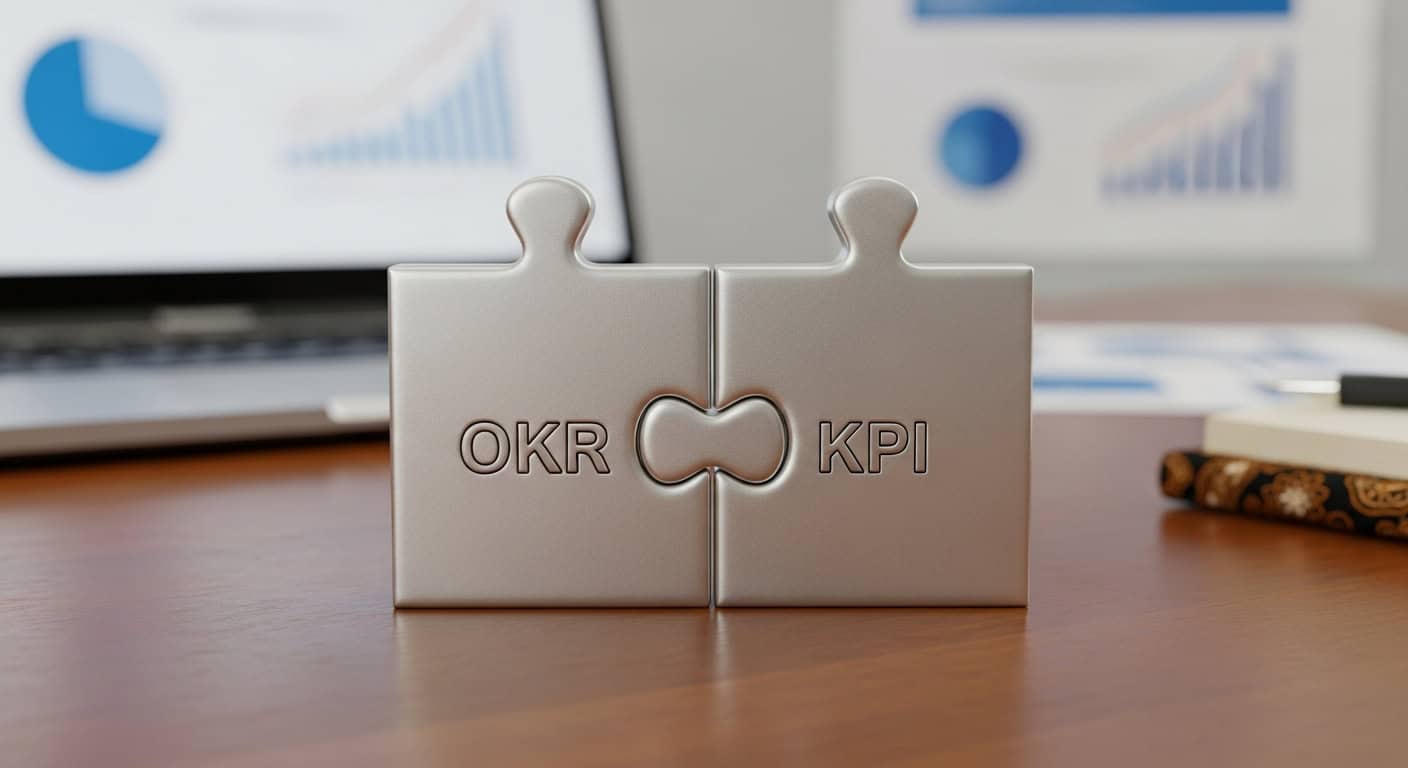
Many people think they have to choose one over the other. However, these two powerful frameworks are not enemies; they are partners in performance. Understanding the difference between Objectives and Key Results (OKRs) and Key Performance Indicators (KPIs) is the first step. Consequently, learning how to use them together can transform your company’s growth trajectory.
This guide will clarify the roles of OKRs and KPIs, explain how they fit into performance management, and show you how to leverage both to achieve remarkable results.
First, What Is a KPI? (Key Performance Indicator)
Think of a KPI as a health monitor for your business. A Key Performance Indicator is a measurable value that shows how effectively a company is achieving key business objectives. In other words, KPIs measure the success and stability of your ongoing, day-to-day activities.
The primary purpose of a KPI is to monitor performance and maintain established standards. It tells you if you are on track with your existing processes.
For example, different departments in a Malaysian business might track the following KPIs:
- Sales Team: Monthly recurring revenue (MRR) or customer acquisition cost (CAC).
- HR Department: Employee turnover rate or time-to-hire in days.
- Marketing Team: Website traffic or lead-to-customer conversion rate.
- Customer Support: Average ticket response time or customer satisfaction score (CSAT).
KPIs are essential for ensuring operational excellence and identifying problems before they escalate.
Then, What Is an OKR? (Objectives and Key Results)
If a KPI is a health monitor, an OKR is a roadmap to a bold new destination. Popularized by companies like Google, the OKR framework is designed to set and achieve ambitious goals. It pushes teams to stretch beyond their limits and focus on what truly matters.
An OKR is made up of two simple but powerful components:
Objective: What do we want to achieve?
An Objective is a memorable, qualitative description of what you want to accomplish. It should be significant, concrete, and action-oriented. Most importantly, it should be inspiring.
Key Results: How will we measure our progress?
Key Results are a set of quantitative metrics that measure your progress toward the Objective. You should typically have 2-5 Key Results per Objective. They must be specific, measurable, and verifiable. If you hit your Key Results, you achieve your Objective.
Here’s a simple example:
- Objective: Become the top-rated HR software provider in the Klang Valley.
- Key Results:
- Increase our average customer rating from 4.2 to 4.8 stars on major review sites.
- Secure 25 new 5-star video testimonials from local clients.
- Reduce customer support response time by 50%.
OKR vs KPI: The Key Differences at a Glance
While both frameworks use metrics, their purpose and application are fundamentally different. Understanding this distinction is crucial for effective goal setting.
Purpose: Setting Goals vs. Measuring Performance
The primary difference lies in their intent. OKRs are a goal-setting framework designed to drive change and innovation. They answer the question, “Where do we want to go?” In contrast, KPIs are a performance measurement tool that monitors the health of existing processes. They answer the question, “How are we doing right now?”
Nature: Ambitious “Moonshots” vs. Attainable Targets
OKRs are intentionally ambitious. They are “moonshots” designed to stretch a team’s capabilities. Reaching 70% of an OKR is often considered a success. On the other hand, KPIs are typically attainable targets that reflect the expected output of a process. You should aim to hit 100% of your KPI targets consistently.
Cadence: Quarterly Sprints vs. Continuous Monitoring
OKRs usually operate on a shorter, fixed cadence, often quarterly. This creates a sense of urgency and allows teams to adapt quickly. KPIs, however, are monitored continuously—daily, weekly, or monthly—as part of ongoing business operations.
Focus: Driving Change vs. Maintaining Stability
Use OKRs when you want to innovate, enter a new market, or fundamentally improve a part of your business. Use KPIs to ensure that your core business functions are running efficiently and effectively.
For a quick summary, here’s a comparison table:
| Feature | OKR (Objectives and Key Results) | KPI (Key Performance Indicators) |
|---|---|---|
| Purpose | To set ambitious goals and drive change | To measure the health of ongoing operations |
| Nature | Aspirational and ambitious (“moonshots”) | Attainable and predictable |
| Goal | To achieve significant growth or change | To maintain performance and quality |
| Cadence | Typically set quarterly or annually | Monitored continuously |
| Focus | Leading indicator of future success | Lagging indicator of past performance |
The Big Question: Can OKRs Be Used in Performance Management?
This is one of the most debated topics surrounding OKRs. The short answer is yes, but with extreme caution. How you integrate OKRs into your performance appraisal process can either supercharge your team’s motivation or destroy it.
The Pitfall: Why You Shouldn’t Tie OKRs to Bonuses
The biggest mistake companies make is directly linking OKR achievement to compensation and bonuses. This practice is highly discouraged by experts like John Doerr, who introduced OKRs to Google.
Here’s why: if employees know their bonus depends on hitting 100% of their Key Results, they will stop setting ambitious goals. Instead, they will “sandbag” by setting safe, easily achievable targets. This completely defeats the purpose of OKRs, which is to encourage stretching and innovation. OKRs are a tool for learning and pushing boundaries, where even a “failure” to reach 100% provides valuable insights.
The Smart Way: Using OKRs to Inform Performance Reviews
Instead of being a grading tool, OKRs should be a conversation starter. They provide rich context for performance reviews. During a review, a manager and employee can discuss:
- Contribution: How did the employee’s work contribute to the team’s OKRs?
- Ambition: Were the goals they set challenging enough?
- Problem-Solving: What obstacles did they face, and how did they try to overcome them?
- Learnings: What was learned from both successes and failures?
This approach shifts the focus from a simple score to a meaningful discussion about growth, effort, and impact. It supports a culture of psychological safety where employees feel empowered to take risks.
The Power of Two: How OKRs and KPIs Work Together
The most effective organizations don’t choose OKR vs KPI; they use them in harmony. Your KPIs give you a real-time view of your business health, which in turn helps you set better OKRs.
Think of it this way: KPIs are your car’s dashboard. The speedometer, fuel gauge, and engine temperature tell you if everything is running as it should. OKRs are your GPS. They give you turn-by-turn directions to a new, exciting destination you’ve never been to before.
You need both to complete your journey successfully.
Here’s a practical example. Imagine an e-commerce company in Malaysia is tracking a KPI for “Shopping Cart Abandonment Rate.” They notice this KPI is trending dangerously high. This health metric signals a problem. In response, the leadership team could set a new quarterly OKR:
- Objective: Create a frictionless checkout experience.
- Key Results:
- Reduce the number of steps in the checkout process from 5 to 3.
- Increase payment success rate by 15%.
- Achieve a user-tested satisfaction score of 9/10 for the new checkout flow.
Here, the KPI flagged an issue, and the OKR was created to solve it.
How Worksy Simplifies Goal Management for Your Business
Managing both OKRs and KPIs effectively can be complex without the right tools. Spreadsheets can quickly become messy and disconnected from the day-to-day workflow. This is where a dedicated HR system becomes invaluable.
Worksy’s Performance Appraisal module is designed to help Malaysian businesses simplify and streamline their entire performance and goal management process.
Centralise OKRs and KPIs in One Platform
With Worksy, you can set, track, and manage both company-wide OKRs and individual KPIs in a single, accessible platform. This ensures everyone, from top leadership to new hires, understands the company’s priorities and how their work contributes to them. This transparency is key for alignment and motivation.
Automate Check-ins and Track Progress Seamlessly
Forget chasing employees for manual updates. Worksy helps you automate regular check-ins, making it easy for teams to update their progress on Key Results. Real-time dashboards provide managers with an at-a-glance view of team performance, allowing them to offer support when it’s needed most.
Link Goals to Meaningful Performance Conversations
Worksy facilitates the modern approach to performance management discussed earlier. By separating goal tracking from the formal review, our system helps you use goal data as a basis for constructive, forward-looking conversations. It provides a framework to simplify employee performance management without turning OKRs into a punitive grading tool.
Conclusion: Drive Your Malaysian Business Forward with the Right Goals
Ultimately, the OKR vs KPI debate is a false choice. KPIs help you keep your business stable and healthy, while OKRs push you to innovate and achieve breakthrough results. Using both frameworks together creates a powerful system that balances operational excellence with ambitious growth.
By adopting this dual approach and supporting it with a robust tool like Worksy, you can foster a culture of high performance, accountability, and continuous improvement. Stop just measuring what you did yesterday—start building what you want to achieve tomorrow.
Ready to transform your company’s performance? Discover how Worksy’s Performance Appraisal module can help you set and achieve your most ambitious goals.
Frequently Asked Questions (FAQ)
Q1: What is the main difference between an OKR and a KPI?
The main difference is their purpose. A KPI (Key Performance Indicator) measures the ongoing health and performance of an existing process or activity. An OKR (Objectives and Key Results) is a goal-setting framework designed to drive significant change and achieve ambitious, time-bound goals.
Q2: Should my company use OKRs instead of KPIs?
No, you should use both. They serve different but complementary functions. Use KPIs to monitor your business-as-usual operations and use OKRs to execute strategic priorities and drive growth. It is not a matter of replacement but of integration.
Q3: Why is it a bad idea to use OKRs for performance measurement?
Directly tying OKR achievement to bonuses or salary discourages risk-taking. Employees will set safe, easy goals to ensure they get their reward, which defeats the purpose of OKRs as a tool for setting ambitious “stretch” goals. Instead, use them to inform performance conversations about contribution and learning.
Q4: How do we get started with implementing OKRs?
Start small. Begin with a single team or department for a trial quarter. Focus on teaching them how to write good, ambitious Objectives and measurable Key Results. As described in the renowned book “Measure What Matters” by John Doerr, the goal is to create focus, alignment, and engagement around your strategic priorities.